Machines
Analyst-grade vibration reports in minutes.
Upload route data. Tested deterministic code computes every number — ISO 20816 classification, bearing fault identification, computed confidence. An AI drafts the narrative; a verifier checks every claim against the math. You review and sign.
1 · How a report is made
Upload route data.
Spectrum or raw waveform, straight off the collector. WAV, UFF and MAT have their FFT computed here — you do not have to export a spectrum first.
Confirm how we read it.
An unfamiliar layout is worked out, shown back to you in the reading it produced, and waits for your OK. Nothing is analysed before you agree.
Review and sign.
Every claim in the draft is checked against the computed result before issue. You get a DRAFT to review and sign. The signature stays human.
Agentic where it helps. Deterministic where it matters. Honest where it can’t assess — every limitation is stated, with the measurement that resolves it.
2 · Benchmarked in public
Scored against the CWRU and MFPT laboratory corpora and a 2 MW wind turbine’s high-speed shaft. Every number is measured, and every miss is stated as a miss. Read the validation record.
3 · The report is the product
Three pages from the sample report — a synthetic compressor with a seeded outer-race fault, drafted by the same path your own file takes.
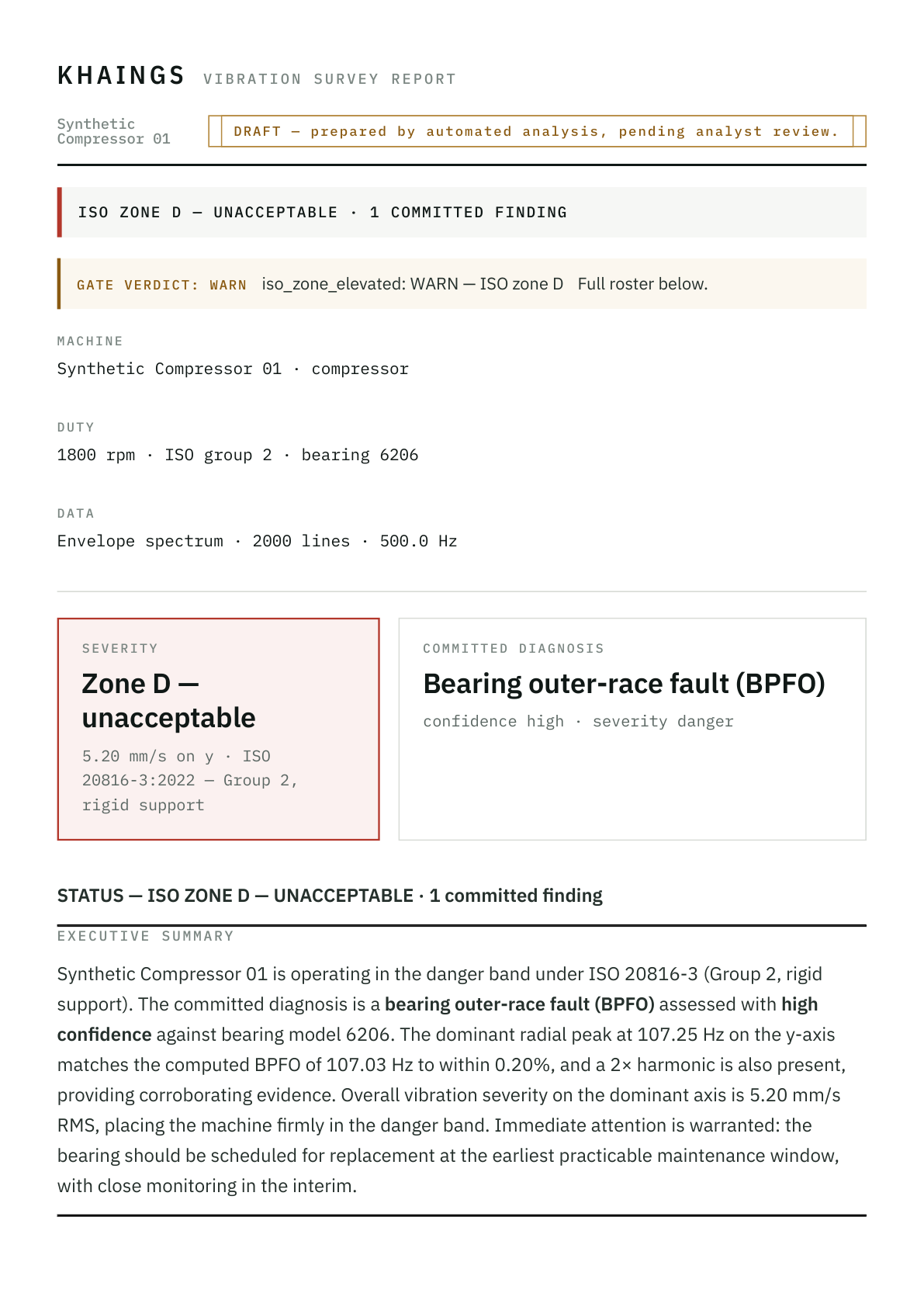
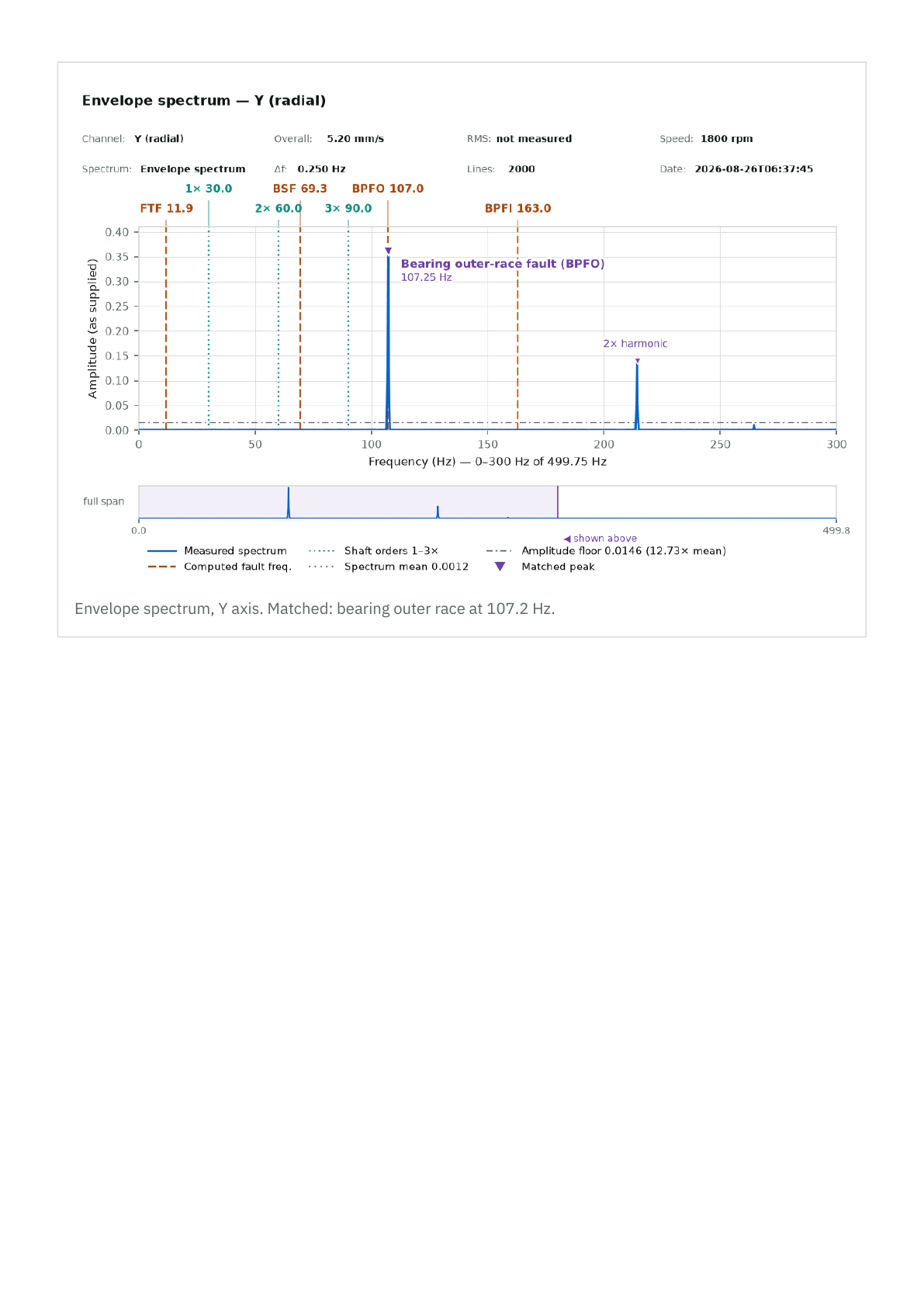
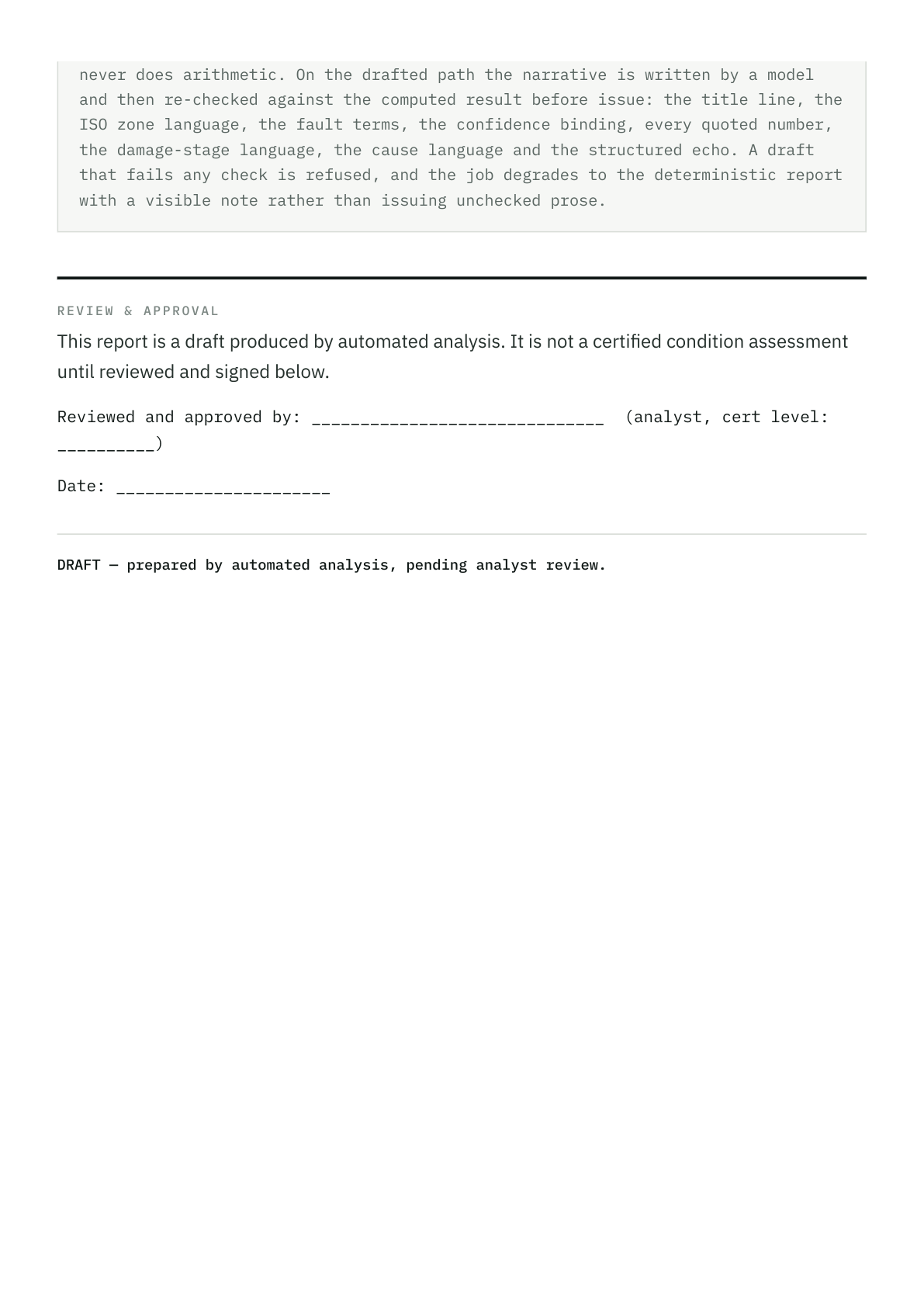
See a sample report the full 22 pages, as issued
4 · Start
No account. Your raw file is deleted as soon as it has been read.
The example is a real outer-race bearing fault — 6206 bearing, 1800 rpm, radial spectrum. One tap fills the form and runs it through the same pipeline, the same drafting pass and the same verification as your own file. Nothing about it is canned. You need only an invite code.
Upload · one machine per report
- 1 Machine
- 2 Measurement
- 3 Details
- 4 Review